Description
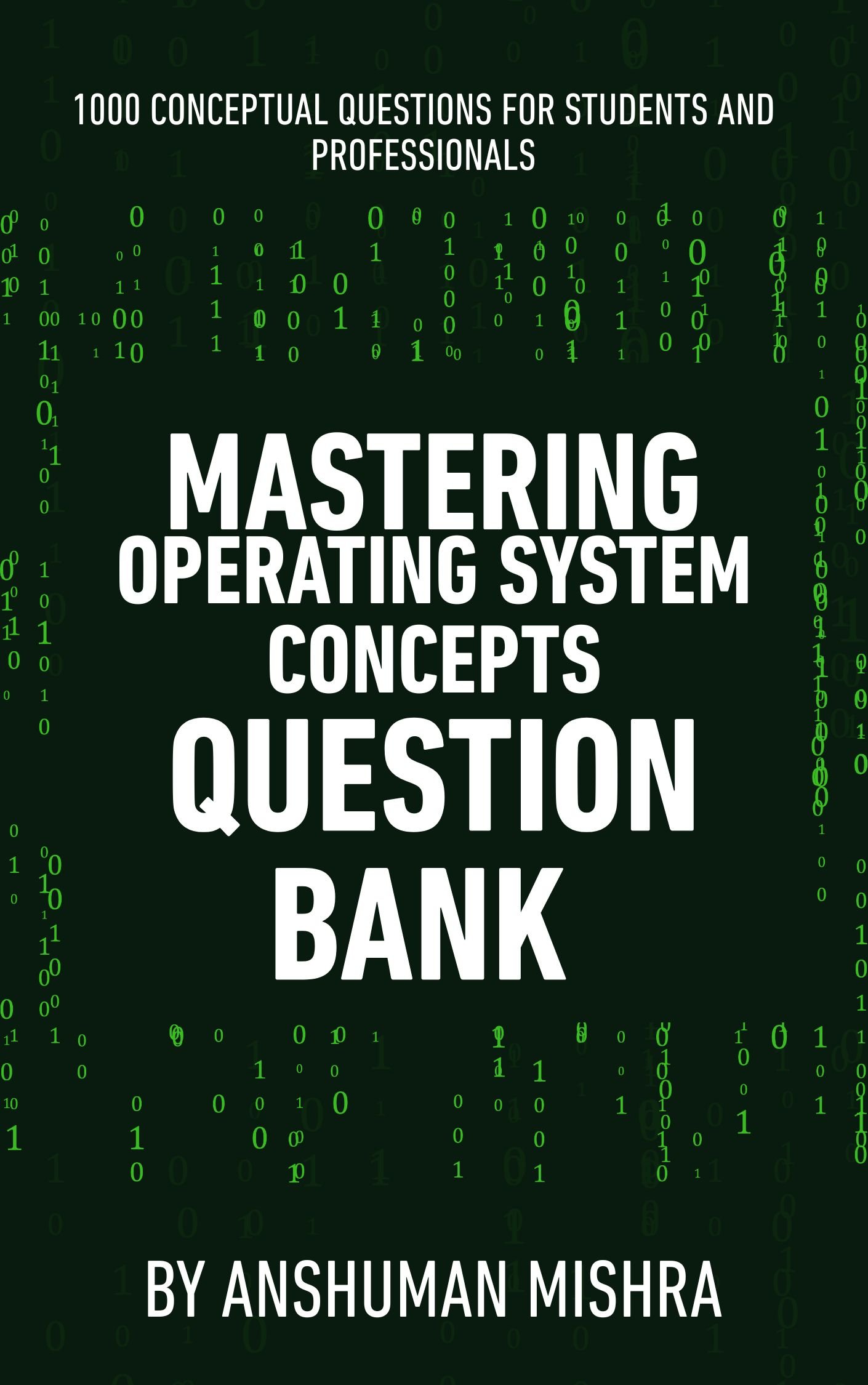
Mastering Operating System Concepts QUESTION BANK
1000+ Conceptual Questions for Students and Professionals
Subtitle:
A Comprehensive Question Bank with MCQs, Short and Mid-Length Questions, and Numericals – For BCA, MCA, B.Tech, M.Tech & Software Interviews
Author: Anshuman Mishra
Published by: Anshuman Mishra
Publication Year: 2025
About the Book
Operating Systems is one of the most important subjects in Computer Science and Information Technology. It provides the foundation for understanding how computers manage processes, memory, files, storage, hardware resources, security, and system-level operations.
Mastering Operating System Concepts QUESTION BANK is designed as a comprehensive practice and revision resource containing 1000+ conceptual and application-oriented questions covering the major areas of Operating Systems.
Instead of relying only on theoretical explanations, this book emphasizes active learning through questions and problem solving. It helps readers test their understanding, identify weak areas, practice numerical problems, and prepare effectively for academic examinations as well as technical interviews.
The question bank progresses from fundamental concepts to advanced topics and real-world operating-system scenarios.
What This Question Bank Contains
Each chapter follows a structured question pattern containing:
- 50 MCQs
- 25 Short Answer Questions
- 15 Mid-Length Answer Questions with Answers
- 20 Numerical / Scenario-Based Problems with Solutions
Across 10 chapters, the book provides a large collection of questions covering both conceptual understanding and practical problem solving.
The numerical and scenario-based sections are particularly useful for topics such as:
- CPU Scheduling
- Deadlocks
- Paging
- Memory Management
- TLB and Address Translation
- Page Replacement
- Disk Scheduling
- I/O Systems
- System Performance
Chapter-Wise Coverage
Chapter 1: Introduction to Operating Systems
This chapter establishes the fundamental concepts of operating systems.
Topics include:
- Definition and objectives of an OS
- Functions of operating systems
- Types of operating systems
- Batch operating systems
- Time-sharing systems
- Real-time operating systems
- Distributed operating systems
- Embedded operating systems
- OS services
- User interfaces
- System calls
- Monolithic architecture
- Microkernel architecture
- Layered architecture
Question Set:
✔ 50 MCQs
✔ 25 Short Answer Questions
✔ 15 Mid-Length Questions with Answers
✔ 20 Numerical Problems with Solutions
Chapter 2: Process Management and CPU Scheduling
This chapter focuses on processes and the algorithms used to allocate CPU resources.
Topics include:
- Process concepts
- Process states
- Process Control Block
- Context switching
- Long-term scheduler
- Short-term scheduler
- Medium-term scheduler
- FCFS scheduling
- SJF scheduling
- Round Robin scheduling
- Priority scheduling
Numerical problems help readers calculate scheduling measures such as waiting time, turnaround time, response time, and completion time.
Chapter 3: Threads, Multithreading and Synchronization
This chapter examines concurrent execution and synchronization mechanisms.
Topics include:
- Threads
- Benefits of multithreading
- Multithreading models
- Mutex
- Semaphore
- Monitor
- Critical-section problem
- Producer-Consumer problem
- Readers-Writers problem
- Dining Philosophers problem
The questions help learners understand both theoretical synchronization concepts and practical concurrency scenarios.
Chapter 4: Deadlock Detection, Prevention, and Recovery
Deadlocks are an essential topic in Operating Systems and technical examinations.
This chapter covers:
- Deadlock characterization
- Necessary conditions
- Resource Allocation Graph
- Deadlock prevention
- Deadlock avoidance
- Banker’s Algorithm
- Deadlock detection
- Deadlock recovery
Numerical and scenario-based exercises provide practice in determining safe states, unsafe states, resource allocation, and possible deadlock situations.
Chapter 5: Memory Management and Paging
This chapter focuses on how operating systems manage main memory.
Topics include:
- Contiguous memory allocation
- Non-contiguous allocation
- Paging
- Segmentation
- Translation Lookaside Buffer
- Effective Memory Access Time
- Internal fragmentation
- External fragmentation
- Paging hardware
- Address translation
The numerical section provides practice with page numbers, offsets, address translation, TLB calculations, and memory-access problems.
Chapter 6: Virtual Memory and Page Replacement
Virtual memory enables operating systems to efficiently manage programs that require more memory than is physically available.
Topics include:
- Demand paging
- Page faults
- Demand-paging performance
- FIFO page replacement
- LRU page replacement
- Optimal page replacement
- Thrashing
- Working Set Model
Readers practice page-reference strings and calculate page faults and replacement behavior using different algorithms.
Chapter 7: File System Interface and Implementation
This chapter focuses on how operating systems organize, access, and protect files.
Topics include:
- File concepts
- File attributes
- File access methods
- Directory structures
- File-system mounting
- File-system implementation
- Inodes
- File allocation methods
- Directory implementation
- File protection
The question sets reinforce both conceptual and implementation-level understanding.
Chapter 8: Disk Scheduling and I/O Systems
This chapter examines storage devices and input/output management.
Topics include:
- Disk structure
- FCFS disk scheduling
- SSTF
- SCAN
- LOOK
- Disk management
- RAID levels
- I/O hardware
- I/O software
- Buffering
- Caching
- Spooling
Numerical problems provide practical experience in calculating disk head movement and scheduling performance.
Chapter 9: Protection and Security in Operating Systems
Security is a critical component of modern operating systems.
This chapter covers:
- Principles of protection
- Access Control Lists
- Capability-based protection
- Security problems
- Cryptography fundamentals
- User authentication
- Security threats
- Firewalls
- Intrusion Detection Systems
The questions help readers connect classical OS protection mechanisms with modern system-security concepts.
Chapter 10: Case Studies – Linux and Windows OS Internals
The final chapter brings theoretical knowledge into real operating-system environments.
Topics include:
- Linux kernel overview
- Linux process management
- Linux memory management
- Windows architecture
- Windows subsystems
- Windows file systems
- Windows security
- Comparative OS concepts
Scenario-based questions help readers analyze real-world operating-system behavior.
Key Features
1. 1000+ Questions
A large collection of questions provides extensive practice across the complete Operating Systems syllabus.
2. Multiple Question Formats
The book includes:
- MCQs
- Short-answer questions
- Mid-length questions
- Numerical problems
- Scenario-based questions
- Solutions and explanations
3. Numerical Problem Practice
Special attention is given to numerical areas frequently encountered in university examinations and competitive exams.
4. Conceptual Learning
The questions are designed not merely to test memorization but to develop understanding of why and how operating-system mechanisms work.
5. Interview Preparation
The question bank is useful for technical interviews involving:
- Processes
- Threads
- Scheduling
- Memory
- File systems
- Synchronization
- Deadlocks
- Linux
- Windows
- Security
6. Competitive Examination Support
The content can support preparation for:
- GATE Computer Science
- UGC-NET Computer Science
- University examinations
- Technical entrance examinations
- Recruitment examinations
Benefits of Using This Question Bank
Academic Preparation
Students can use the book for:
- Semester examination preparation
- Internal assessments
- Assignments
- Tutorials
- Viva preparation
- Laboratory discussions
- Revision
Conceptual Mastery
Regular practice helps learners identify gaps in their understanding and strengthen fundamental OS concepts.
Numerical Skill Development
Repeated practice with scheduling, paging, memory, deadlock, and disk problems improves numerical accuracy and problem-solving speed.
Interview Readiness
The question bank helps candidates prepare for common Operating Systems questions asked in software and IT interviews.
Competitive Exam Preparation
MCQs and numerical problems provide useful practice for objective and analytical examinations.
Who Should Read This Book?
This question bank is suitable for:
- BCA Students
- MCA Students
- B.Tech / BE Students
- M.Tech Students
- Computer Science Students
- Information Technology Students
- Software Engineering Students
- GATE Aspirants
- UGC-NET Aspirants
- Technical Interview Candidates
- Software Developers
- System Programmers
- Linux Learners
- Computer Science Faculty
- Operating Systems Educators
- IT Professionals
Topics Covered at a Glance
Operating Systems → Processes → CPU Scheduling → Threads → Synchronization → Deadlocks → Memory Management → Paging → Virtual Memory → Page Replacement → File Systems → Disk Scheduling → I/O Systems → RAID → Security → Protection → Linux → Windows
This makes the book a useful single-volume practice resource for Operating Systems.
What You Will Gain
After working through this question bank, readers will be better prepared to:
✔ Explain fundamental OS concepts
✔ Analyze process states and process management
✔ Solve CPU scheduling problems
✔ Understand thread and synchronization mechanisms
✔ Analyze deadlock situations
✔ Apply Banker’s Algorithm
✔ Solve paging and memory-management problems
✔ Calculate TLB and memory-access values
✔ Analyze page-replacement algorithms
✔ Understand file-system implementation
✔ Solve disk-scheduling problems
✔ Understand I/O mechanisms
✔ Explain RAID concepts
✔ Understand OS protection and security
✔ Compare Linux and Windows internals
✔ Approach Operating Systems interview questions confidently
✔ Solve conceptual and numerical examination problems
Ideal For
University Exams | GATE | UGC-NET | Viva | MCQ Practice | Technical Interviews | Assignments | Tutorials | OS Revision | Competitive Examinations
Book Information
Title: Mastering Operating System Concepts QUESTION BANK
Subtitle: 1000+ Conceptual Questions for Students and Professionals
Format: Question Bank / Academic Reference
Subject: Operating Systems
Level: Undergraduate, Postgraduate and Professional
Author: Anshuman Mishra
Publisher: Anshuman Mishra
Year: 2025
Reviews
There are no reviews yet.