Description

Mastering Python OOPs QUESTION BANK: 1000+ Conceptual Questions for Students and Professionals
A Comprehensive Question Bank with MCQs, Short and Mid-Length Questions – For BCA, MCA, B.Tech, M.Tech & Software Interviews
Strong programming knowledge requires more than simply reading concepts. Students and professionals need regular practice, conceptual revision, problem-solving, and exposure to different types of questions.
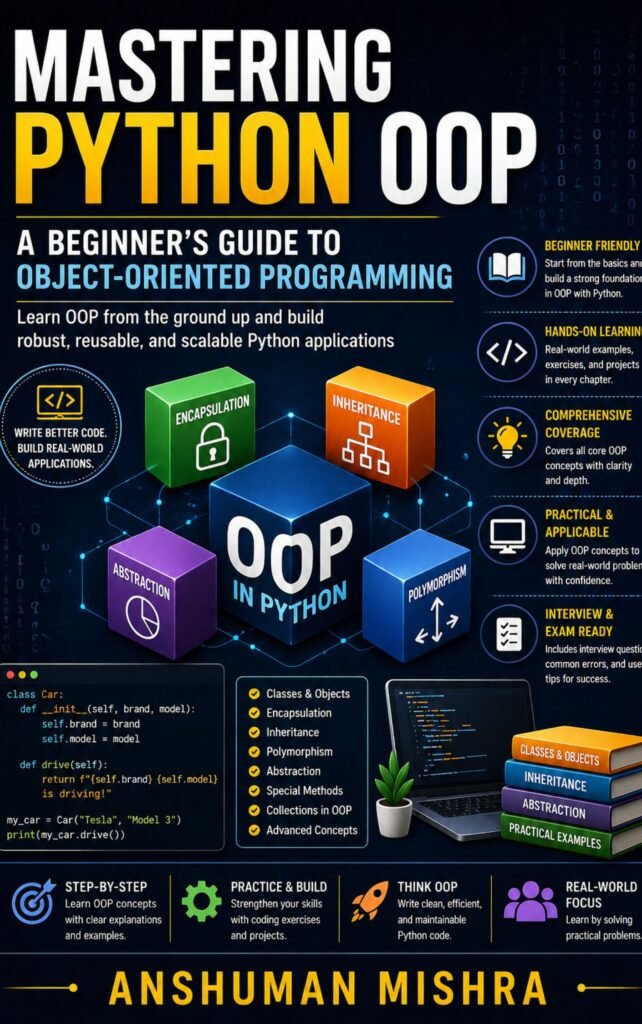
Mastering Python OOPs QUESTION BANK: 1000+ Conceptual Questions for Students and Professionals is designed as a comprehensive question bank for learning, examination preparation, classroom practice, assignments, technical interviews, and programming revision.
The book focuses specifically on Object-Oriented Programming in Python and systematically covers concepts ranging from classes and objects to inheritance, polymorphism, abstraction, operator overloading, magic methods, introspection, composition, and reusable OOP system design.
Each chapter combines different question formats to help readers develop both conceptual understanding and practical programming skills.
What Does This Question Bank Cover?
The book is organized into 12 comprehensive chapters, covering the essential and advanced concepts of Python OOP.
Chapter 1: Introduction to Python OOP
The question set begins with the fundamentals of Object-Oriented Programming.
Topics include:
- Overview of OOP
- Importance of OOP
- Procedural vs. Object-Oriented Programming
- Classes and objects
__init__self- Creating classes and objects
This chapter establishes the foundation required for understanding the remaining OOP concepts.
Chapter 2: Classes and Objects
This section focuses on the fundamental building blocks of Python OOP.
Readers practice questions related to:
- Defining classes
- Instantiating objects
- Attributes
- Instance variables
- Class variables
- Instance variables
- The
__init__()method
Chapter 3: Encapsulation
The question bank explores how Python programmers organize and control data within classes.
Topics include:
- Public, protected, and private attributes
- Getters and setters
- Name mangling
- Access control
- Data hiding
- Practical encapsulation scenarios
Chapter 4: Inheritance
Inheritance is one of the core principles of OOP, and this chapter provides extensive practice on:
- Single inheritance
- Multilevel inheritance
- Hierarchical inheritance
- Multiple inheritance
- Method overriding
super()- Method Resolution Order (MRO)
- Practical inheritance scenarios
Chapter 5: Polymorphism
Readers explore different ways Python supports flexible and reusable programming.
Questions cover:
- Polymorphism
- Function overloading approaches
- Default and variable arguments
- Operator overloading
- Method overriding
- Duck typing
- Real-world polymorphism
Chapter 6: Abstraction
This chapter focuses on designing systems around essential behavior while separating implementation details.
Topics include:
- Abstraction in OOP
- Abstract Base Classes
- The
abcmodule - Abstract methods
- Interfaces
- Practical implementation scenarios
Chapter 7: Constructors and Destructors
The book provides extensive practice on object initialization and cleanup.
Topics include:
__init__()- Default constructors
- Parameterized constructors
__del__()- Constructor design
*args**kwargs
Chapter 8: Class Methods and Static Methods
This chapter helps learners distinguish between different types of methods in Python.
Topics include:
- Instance methods
- Class methods
- Static methods
@classmethod@staticmethod- Practical use cases
- Bound and unbound method concepts
Chapter 9: Inner and Nested Classes
Readers practice concepts related to classes defined within other classes.
Topics include:
- Inner classes
- Nested classes
- Syntax and implementation
- Accessing the outer class
- Practical applications
- Real-world use cases
Chapter 10: Operator Overloading
This chapter focuses on customizing the behavior of Python operators for user-defined objects.
Questions cover:
- Operator overloading
- Special methods
__add__()__sub__()- Custom mathematical behavior
- Complex numbers
- Vectors
- Practical programming problems
Chapter 11: Magic Methods / Dunder Methods
Python’s special methods are essential for understanding how objects interact with the language itself.
This chapter covers:
- Magic methods
- Dunder methods
__str__()__repr__()__len__()- Operator-related methods
- User-defined object behavior
Chapter 12: Advanced OOP Concepts
The final chapter takes learners toward more advanced Python OOP concepts.
Topics include:
- Multiple inheritance
- MRO
super()- Composition vs. inheritance
- Object introspection
isinstance()hasattr()getattr()- Reusable OOP systems
- Scalable object-oriented design
Question Formats Included
Every chapter follows a structured question pattern designed to support multiple learning and assessment needs.
MCQs
Each chapter contains 50 Multiple Choice Questions, helping readers test their understanding of important concepts and prepare for objective examinations.
Short Answer Questions
Each chapter contains 25 Short Answer Questions for quick revision and conceptual practice.
Mid-Length Questions with Answers
Each chapter contains 15 Mid-Length Questions with Answers, helping students prepare for descriptive examinations and written assessments.
Programming Questions with Answers
Each chapter also contains 20 Programming Questions with Answers, allowing learners to apply OOP concepts through Python programming problems.
Why This Question Bank Is Useful
1. Exam Preparation
The structured question format makes the book useful for semester examinations, internal assessments, practical examinations, assignments, and revision.
2. Conceptual Revision
Instead of reading theory repeatedly, students can use questions to identify gaps in their understanding and revise important Python OOP concepts.
3. Programming Practice
The programming questions encourage readers to translate theoretical OOP concepts into working Python programs.
4. Technical Interview Preparation
The question bank can help Python learners prepare for technical discussions and interviews by revising commonly tested OOP concepts.
5. Classroom and Teaching Support
Teachers and instructors can use the question bank to develop:
- Class tests
- Assignments
- Practice sheets
- Internal examinations
- Question papers
- Viva preparation
- Programming exercises
Ideal for Academic Courses
This book is particularly suitable for students pursuing:
- BCA
- MCA
- B.Tech
- M.Tech
- Computer Science
- Information Technology
- Data Science
- Artificial Intelligence
- Software Development
It can also be useful for independent Python learners and professionals who want to strengthen their OOP fundamentals.
Key Features
✔ 1000+ conceptual and practical questions
✔ 12 chapters covering Python OOP
✔ 50 MCQs per chapter
✔ 25 short-answer questions per chapter
✔ 15 mid-length questions with answers per chapter
✔ 20 programming questions with answers per chapter
✔ Covers beginner to advanced OOP concepts
✔ Useful for semester examinations
✔ Helpful for assignments and classroom practice
✔ Programming-oriented learning
✔ Useful for technical interview preparation
✔ Suitable for students and professionals
Who Should Use This Book?
This question bank is ideal for:
- Python programming students
- BCA students
- MCA students
- B.Tech students
- M.Tech students
- Computer Science learners
- Programming instructors
- Python developers
- Software engineering aspirants
- Technical interview candidates
- Students preparing for practical examinations
- Professionals revising Python OOP concepts
A Complete Python OOP Practice Resource
Mastering Python OOPs QUESTION BANK brings together objective questions, descriptive questions, conceptual problems, and programming exercises in one structured resource.
Whether you are preparing for a university examination, programming assignment, practical assessment, technical interview, or professional skill development, this book provides extensive opportunities to practice Python Object-Oriented Programming.
Learn the concept. Test your knowledge. Practice the code. Strengthen your Python OOP skills.
Reviews
There are no reviews yet.