Description
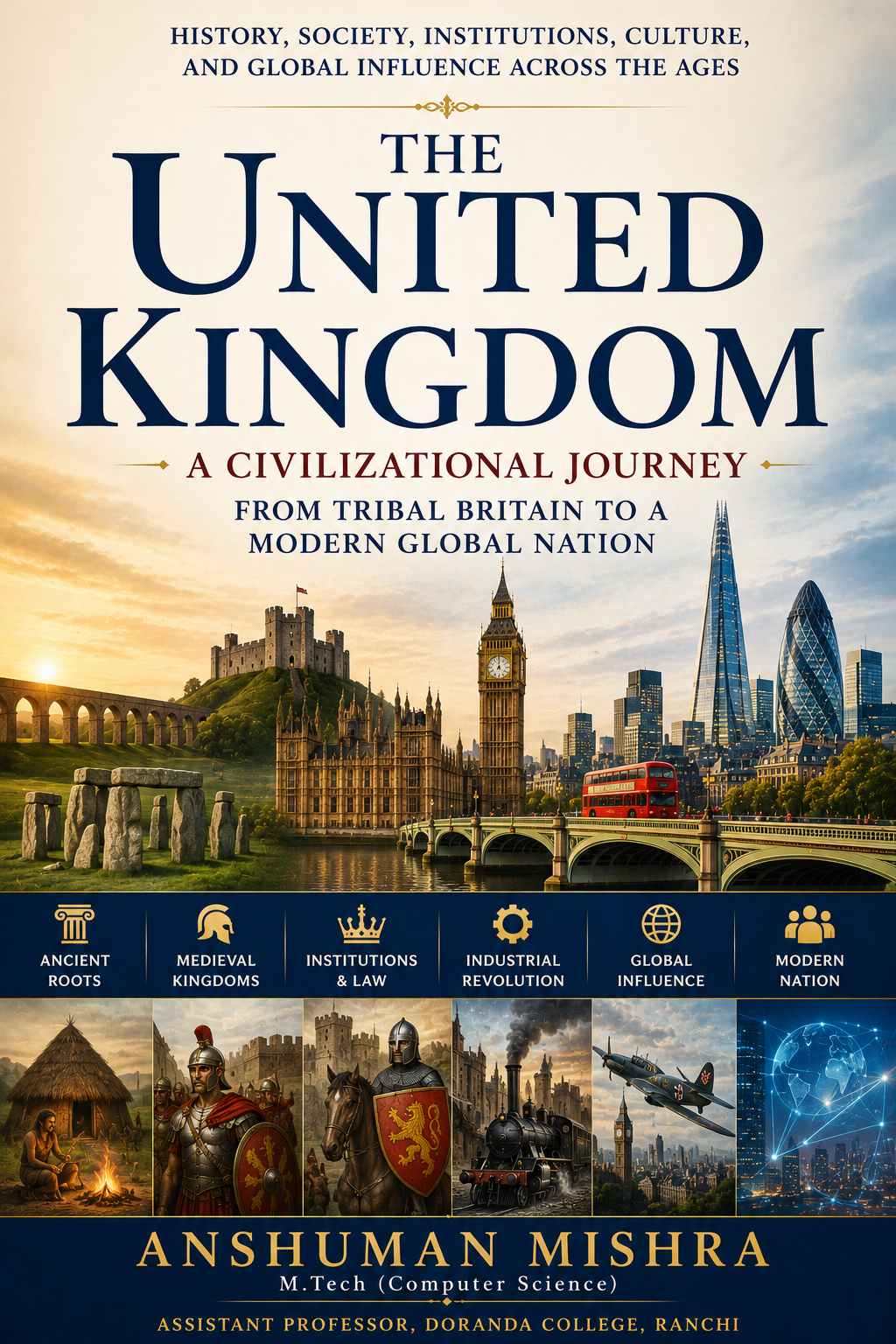
The United Kingdom: A Civilizational Journey from Tribal Britain to a Modern Global Nation
History, Society, Institutions, Culture, and Global Influence Across the Ages
The history of the United Kingdom is one of continuous transformation, shaped by geography, migration, cultural exchange, institutional development, technological innovation, and evolving democratic traditions. From prehistoric communities and Celtic tribes to Roman administration, medieval kingdoms, constitutional government, industrial leadership, and modern global influence, Britain’s story reflects centuries of adaptation, resilience, and institutional evolution.
The United Kingdom: A Civilizational Journey from Tribal Britain to a Modern Global Nation presents a comprehensive, balanced, and academically grounded study of British civilization through a long-term historical perspective. Rather than focusing only on kings, battles, or political events, this book examines the development of society, governance, law, economy, education, religion, culture, science, and international influence that collectively shaped the modern United Kingdom.
The journey begins with prehistoric Britain, where readers explore the lives of Paleolithic hunter-gatherers, Neolithic farming communities, Bronze Age societies, and Iron Age tribal cultures. These early chapters explain how geography, natural resources, rivers, coastlines, and climate influenced settlement patterns, trade, agriculture, and social organization across the British Isles.
The book then examines Celtic Britain, highlighting the language, traditions, spiritual beliefs, governance, craftsmanship, and oral culture of early British societies. Roman Britain is presented as a transformative era that introduced urban planning, roads, administration, legal institutions, engineering, and commercial networks that influenced British development for centuries.
The formation of early England is explored through the Anglo-Saxon migrations, the establishment of kingdoms, the spread of Christianity, legal traditions, and the emergence of early political institutions. Readers also discover how Viking settlements, trade, warfare, and cultural exchange reshaped Britain’s political landscape while contributing to its evolving identity.
A significant portion of the book focuses on medieval Britain and the gradual development of institutions that continue to influence modern democracy. The Norman Conquest, feudal administration, castles, medieval towns, guilds, education, monasteries, common law, Magna Carta, and the evolution of Parliament are examined as interconnected developments that strengthened governance and the rule of law.
The Tudor and Stuart eras are presented as periods of profound political, religious, and constitutional transformation. Readers gain insight into the Reformation, changing political thought, constitutional development, literature, exploration, education, and the emergence of a more centralized state while understanding how these changes influenced later democratic traditions.
Industrialization receives detailed attention as one of Britain’s most influential historical achievements. The book explains technological innovation, urbanization, manufacturing, transportation, scientific progress, economic growth, labor transformation, and the social changes that accompanied the Industrial Revolution. It also examines the historical development of the British Empire through a balanced discussion of trade, administration, communication, cultural exchange, and global connections.
Modern Britain is explored through the formation of the United Kingdom, the experiences of the World Wars, the growth of democratic institutions, scientific advancement, education, healthcare, multicultural society, economic modernization, technological leadership, and Britain’s continuing role in international cooperation and global affairs.
The concluding chapters encourage readers to reflect on Britain’s enduring institutions, democratic traditions, civic culture, national identity, and ability to adapt to changing global circumstances while maintaining continuity with its historical foundations.
Inside This Book You’ll Discover
- Geography and the historical development of the British Isles
- Prehistoric Britain and early civilizations
- Celtic culture, society, and traditions
- Roman Britain and its lasting legacy
- Anglo-Saxon kingdoms and early English history
- Viking settlements, trade, and cultural integration
- The Norman Conquest and medieval governance
- Magna Carta, Common Law, and Parliament
- Tudor and Stuart political transformation
- The Industrial Revolution and technological innovation
- The British Empire and global historical influence
- Formation of the United Kingdom and constitutional development
- World Wars, democracy, and social reform
- Modern British society, multiculturalism, and education
- Britain’s role in science, technology, diplomacy, and international cooperation
Written in a clear, engaging, and research-based style, this book is ideal for students of history, political science, sociology, international relations, British studies, world civilizations, law, governance, and global studies. It is equally valuable for educators, researchers, competitive examination aspirants, libraries, and general readers seeking a deeper understanding of Britain’s historical development and worldwide influence.
Whether you are studying British civilization, preparing for academic examinations, researching constitutional history, exploring the evolution of democratic institutions, or simply interested in one of the world’s most influential societies, The United Kingdom: A Civilizational Journey from Tribal Britain to a Modern Global Nation offers an insightful and comprehensive guide to Britain’s remarkable historical journey.
By combining cultural history, political evolution, legal development, scientific progress, economic transformation, and global influence, this book presents Britain not merely as a nation-state, but as a civilization whose institutions, ideas, and traditions continue to shape the modern world.



Reviews
There are no reviews yet.